Posted on Leave a comment

REVIEW: Red Pitch – @sohoplace

🎭 Red Pitch
📍@sohoplace
🎟️ PR invite
⭐⭐⭐⭐⭐

Tyrell Williams’ powerful play returns to Bush Theatre, and explores friendship, change and the impact of gentrification.

The story

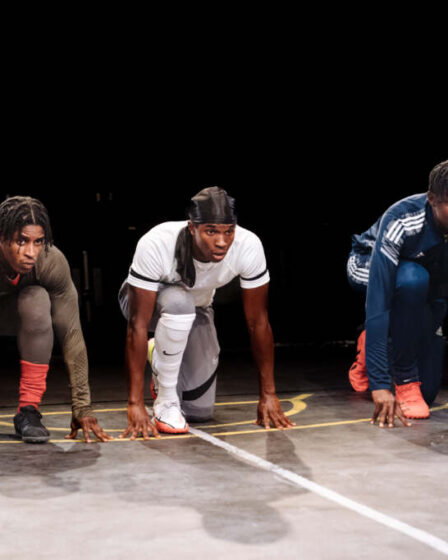
We meet Bilal, Omz and Joey (Kedar Williams Stirling, Francis Lovehall and Emeka Sesay) – 3 Black teenagers and aspiring footballers who hang out on Reedbury estate in South London. The trio frequently play football on ‘Red Pitch’, practicing their skills for when they make it professionally. They banter, bicker, talk about girls and recollect their memories on the estate. Throughout the play, the boys prepare for the demolition of the estate and their impending relocation from ‘ends’. 

As the play unfolds, we discover Bilal, Omz and Joey’s aspirations, their family life, and the pressure and expectations held upon them. The regeneration of their estate has a profound impact and the show cleverly explores the disadvantages and potential benefits of this. This powerful story is about friendship, community, our dreams and change.

Photo by Helen Murray

My thoughts

As soon as we enter the space, we are immersed into Bilal, Omz and Joey’s world. The actors arrive on stage, performing kick-ups, and chatting with the crowd – some audience members even joined them on stage!

Having watched the show at the Bush Theatre, it was amazing to see the elevation of the production in terms of the creative design. We feel like we are directly on the estate, with distant sounds of destruction, rattling from the scaffolding, and protests from the residents – all while the boys talk and play football. Khalil Madovi’s sound design is such a subtle yet significant way to showcase the impending changes.  Amelia Jane Hankin’s football-inspired set design transports us to Red Pitch, with the fenced area and goal markings on the floor. This is supported by incredible lighting from Ali Hunter. During the dream-like sequences, the theatre is lit up like a stadium, where the characters envision scoring goals as professional footballers. It’s a literal snapshot of their aspirations, with the flashing lights, cameras, and encores from the crowd – it felt electric!

Photo by Helen Murray

While we may assume football is the focus, ‘Red Pitch’ covers various topics such as friendship, ambitions, and gentrification. Williams has created an authentic piece of theatre, highlighting a relevant topic in our society, that is rarely seen on stage. Inspired by Williams’ own experiences growing up, the story takes a personal approach as we look at the regeneration through the lens of the characters. Bilal, Omz and Joey have been friends for years and the chemistry between the cast makes this even more believable. All three are fantastic in their roles; they bounce off one another, especially during the comical moments (which were plenty!) and a brilliant dance sequence – it’s a joy to watch! Their portrayal as teenagers was spot on too, and I enjoyed the raw emotion they brought to the characters.

With movement choreographed by Gabrielle Nimo, the cast maintains high energy and an impressive display of stamina and football skills. Under Daniel Bailey’s direction, I enjoyed how the show struck the perfect balance between comedy and sincere moments. It was also interesting to hear the character’s varying views about the regeneration of Reedbury Estate. Omz is hopeful the change will be good for his elderly grandad’s access needs, while Joey appears frustrated that the local Morley’s has been replaced with a coffee shop. The show serves a reminder of the social and economic impact of London’s changing landscape.

Photo by Helen Murray

The storytelling is unique, engaging and a great representation of what it means to have a sanctuary and a shared space. The tapping in and out of the pitch was a genius move, highlighting the bond and what Red Pitch means to Omz, Bilal and Joey. 

The one-act play takes us on an emotional journey as we discover the boy’s family life and the pressures they face. The chemistry between the cast was so palpable that it felt tough watching the characters argue and fight. Kev McCurdy directs one of the most intense and realistic fight scenes I’ve ever seen, as the boys scrap on the pitch. In the quieter, emotional moments, particularly in the final scenes, we see just how much the boys mean to one another. It’s a beautiful, and authentic display of friendship.

You can tell a lot of heart has gone into making this production and I appreciate having stories like this in theatre! With a talented cast and creative team, Red Pitch is funny, thought-provoking, empathetic and refreshing story for the West End. I highly recommend going to see this show!

Red Pitch plays at @sohoplace until 4 May 2024!

Posted on Leave a comment

INTERVIEW: The Cast of ‘For Black Boys’ – Posi Morakinyo, Tobi King Bakare and Mohammed Mansaray.

Following three sold-out runs and award nominations, Ryan Calais Cameron’s ‘For Black Boy Who Have Considered Suicide When The Hue Gets Too Heavy’ returns to the West End with an all-new ensemble.  The play is an authentic exploration of the Black male experience, located on the threshold of joyful fantasy and brutal reality where six men clash and connect in a desperate bid for survival.

I sat down with Posi Morakinyo, Tobi King Bakare and Mohammed Mansaray, who play Midnight, Onyx and Obsidian, to discuss their characters, memorable moments and why they believe people should see the show!

How were the first preview performances?

Tobi: Our first preview was the beginning of a really exciting journey. Doing that first preview wasn’t just a sense of accomplishment, but was an assurance of the work that we’re doing. I was like, ‘We’ve got a sick piece of theatre’. And not only was it good to do, it was good to hear – I’ve never heard a reaction like that. We feel we have a piece of theatre that is doing more than what it says on the box – and that’s just the first preview! 

Posi: It was amazing, we had a lot of energy for it. We wanted to make sure that we were getting that story across. And I think we did. Everyone was electric and buzzing. I remember sitting and watching the energy,  the audience was really loud. I think it was really cool.

Mohammed: The first few previews have been good. That first one [preview], like, we needed that energy. And now we’re just working on it from there. So it’s been good.

What drew you to the production?

Posi: It’s the title. The first three words – For Black Boys. How can you go wrong? As a Black boy in the scene, like there’s nothing like it. I’ve done loads of shows that are similar to the last one. I work with the same people, the same creatives, and similar venues. [For Black Boys] was a familiar difference that I’d never experienced before. Like, I’ve been in space with Black creatives, but not like this. I’ve done Black shows, but not like this. This is a different piece of work. And it’s the beginning of a really exciting wave of new material that is actually shaping the audience’s minds and giving them something other to think about other than a good time. 

Photo by Johan Persson

Tobi: When I watched the show years back, I remember feeling like each and every one of those stories could be mine.  I don’t think I’ve ever felt so seen in a show before as an audience member. I’m sitting there, captivated. going ‘wow, all those stories’. Getting an opportunity to tell these stories and add to that art form – how could I not say yes,  as a young Black man?  Shout out to Ryan [Calais Cameron]. 

Mohammed: I knew some of the guys in the show, so I came to support them. Then I came a second time with my younger brother and thought it’d be good for him to watch it. You don’t see plays like this. If you’re talking about Black theatre in the UK, there have been some prominent Black shows, but shows that talk about the condition of Black men, Black boys, and just really delve into that, you don’t really see shows like that too often. So for me, it was very eye-opening. And it was even better to see it on stage knowing that I can relate to this. But then there’s a plethora of people that are gonna come and see this, and who knows what it’s gonna do for them.

Tell us a bit about your character.

Posi: Midnight is a cool guy. He’s vibes central, always down for a good time. I think he gravitates towards the party. Everything is on the surface. Midnight’s been through life but hasn’t been through it with anybody. Anybody who navigates life alone will tell you even the highs don’t feel that high. Midnight is an isolated individual beyond the surface. It’s tough to play when you can see yourself in a character, and you know their journey. 

Tobi: Onyx is kind of the opposite to me. I’m very smiley, calm and very approachable. Onyx feels the need to be the alpha; he’s hot-headed and impulsive. Onyx is probably the most recognisable character, but not for great reasons. But that’s why the play is so awesome because it shows why and how a boy could end up like that. It all comes down to systematic racism and his environment/surroundings. 

Mohammed: Obsidian is a young man who went through something dark that encouraged him to learn more about his history and empower himself through education. Empower himself through learning about his ancestors, particularly Black African history that has emboldened him. Obsidian is fighting for the evolution of the Black man. He’s fighting for us to go back to the root and understand who we are, as Black people and the people that have come before us and the examples that they’ve given us as to how we can be our best and most authentic selves. I’ve learned a lot from him – the way he’s not scared to be the catalyst for change.

Photo by Johan Persson

How do you find joy while performing the difficult themes in the show?

Tobi: Like yin and yang – pain and joy aren’t exclusive. This show is a brilliant example of that. There’s literally scenes where you go from “haha” to sobbing instantly. That real experience is what makes this show and the writing so captivating. As a Black community, we have joy. Plenty joy. There’s never not enough joy to share. We have moments [in the show] where we talk about praise and worship. For me, the joy reminds me about how important this show is. The way the world has been set up for Black people, sometimes that joy is silenced. This show reminds me that that joy will continue to roll.

Mohammed: We’ve always tried to keep a high spirit because we understand the gravitas and the heaviness of the story. As artists, you have to find a balance. The things these characters go through on stage are a reality for a lot of people. And if you’re not able to relate to it yourself personally, at least one of the six men on that stage might be your brother, cousin, uncle, or grandad. Coming to see a play like this will allow people to better understand and support the people around them. As much as it is heavy, it is a responsibility that we have as artists to service these stories and to do our due diligence in our preparation and telling the stories. It isn’t really about us on stage. It’s about the audience and the people we are telling these stories for.

How do you feel about the use of music and movement to share the emotions of the story?

Mohammed: Some of it was challenging at first. There are elements of Krump in the show. I can dance; I trained in Musical Theatre and was doing ballet every morning for three years. It was good for me to step back into it a bit more. When you understand all the functions of these different forms of expression, and how it serves the story and pushes it forward, you’re really able to embrace it. 

Photo by Johan Persson

Tobi: One of my favourite parts of the show is the opening sequence, seeing six boys moving between each other and just flowing. We’re telling a story of rebirth and the story of birth through our creative expression of moving. Six Black men doing that style of movement, to me, is super powerful and gets me ready to tell some stories. The movement and music in the show are really important additions. 

Posi: We have found so many ways to communicate with one another, that doesn’t just rely on words. The reason why this piece speaks to so many people is because we’re not just talking. Music, movement – it’s more than just a wow factor. It’s a language. And there’ll be somebody refusing to listen as we’re speaking, but cannot refuse the melody that sits on the heart. I try not to think about it as a song or as a dance. I think about it as another form of monologue. The movement and the music add another way of communicating to the audience.

What has been your most enjoyable or memorable moments so far in this production?

Tobi: The most enjoyable moment in the show for me is being held by my brothers. We have a culture where before each performance we come together as men and share a space. I’ve never had that on any other job where I felt like, I’m held by my cast and team. I’m literally physically held. That experience is unmatched.

Posi: Seeing everybody be so invested in this has been the most enjoyable experience. 

Mohammed: The other day, Posi’s friend, who is a caterer, bought soul food for us – oxtail, chicken, mac and cheese, plantain. Those moments of camaraderie and community, off and on stage, are very important to me. Also, our singing moments – when we’re an ensemble, and we’re putting our heart into the songs, it’s like we feel it.

Why should people come and see the show? What do you hope the audiences take from seeing For Black Boys?

Posi: People are talking a lot about it. Everybody should come and see it to have their own opinion. I would hope that everybody can benefit from a piece of theatre like this, that isn’t just enjoyable – it’s educational. It’s informative, it’s insightful. I hope people feel seen. This show does a really good job of capturing the humanity of people. 

Tobi: I hope audiences leave the show, feeling like they can tell their own stories as well. What Ryan does really well about pinpointing these stories, is, it feels like ‘Yeah, I’ve had that experience before.’ He talks about specific things where you still feel like you can relate. I think a show like this with the format, the structure, the openness, the rawness of it – I would love for people to come and leave inspired.

Photo by Johan Persson

Mohammed: So, I like to describe this show as edutainment. Education through entertainment. There’s loads of information that can educate people on the psyche, the human condition and the Black man. 

I hope people take this as a form of enlightenment. I hope that you learn a bit more about Black men; our strengths, our vulnerabilities, our challenges, our happiness. I hope it enables people to understand and appreciate that a bit more. And I hope that if people come in and see themselves represented on the stage – we’ve done our job. I just hope it’s able to bring people together.

For Black Boy Who Have Considered Suicide When The Hue Gets Too Heavy plays at Garrick Theatre until 4 May 2024.

Posted on Leave a comment

REVIEW: Standing at the Sky’s Edge – Gillian Lynne Theatre

🎭 Standing at the Sky’s Edge
📍 Gillian Lynne Theatre
🎟️PR invite
⭐⭐⭐⭐⭐


Following two successful runs in Sheffield and London, and many prestigious awards, Standing at the Sky’s Edge returns to London for a West End run, proving what a remarkable, new musical it is!

Set in a brutalist housing estate in Sheffield, the story spans over 5 decades, focusing on three families who lived in the same flat. Written by Chris Bush, their stories showcase significant moments and changes on the Park Hill estate. In the sixties, we meet newlyweds, Harry and Rose (Joel Harper-Jackson and Rachael Wooding), bursting with optimism and joy as they arrive in their new home, longing to complete their family with a child. In the nineties, we see teenager Joy (Elizabeth Ayodele), a refugee who has fled Liberia with her cousins Grace and George (Sharlene Hector and Baker Mukasa), arriving in Sheffield. In 2015, Poppy (Laura Pitt-Pulford), a Londoner, moves to the regenerated estate, following a breakup with her fiancee.

Photo by Brinkhoff-Moegenburg

All three narratives overlap in this multi-generational story. It is a heartwrenching yet powerful production about hopes and dreams. Sky’s Edge beautifully touches on love, loss and the importance of community. 

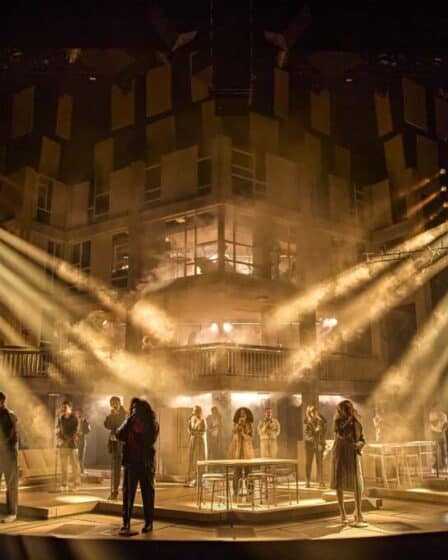
Ben Stone’s set design marvellously replicates the brutalist ‘streets in our sky’ architecture of the Park Hill estate. With towering flats, concrete pillars, walkways, and balconies that see the ensemble walk and dance through. There’s an intimacy with the set design, especially as we watch the band perform across two levels of the set. This is further exemplified by the new space at Gillian Lynne Theatre, which sees the ensemble perform in the theatre aisles. The design is complete with the notable, “I love you, will you marry me?” graffiti, a spectacle to look at during the final scenes, against Mark Henderson’s warm orange and yellow-toned lighting. 

Photo by Brinkhoff-Moegenburg

With music from Sheffield singer-songwriter, Richard Hawley, the musical also guides us through the history of Park Hill and its iconic building over the decades. Bush is a gifted playwright; they brilliantly explore the socioeconomic impact on the Park Hill residents over the years including unemployment, anti-social behaviour and the end of social housing. The show also includes immigration, gentrification and politics. There are references to the 2016 EU Referendum and Thatcher’s policies – key moments in the British political landscape that had an impact on people’s livelihoods and society as a whole. 

Photo by Brinkhoff-Moegenburg

This is unlike most ‘jukebox’ musicals and is incredibly unique with how the themes are presented. Under Robert Hastie’s direction, the three timelines are intertwined, and performed simultaneously on stage, with the characters sharing the living space. It’s an ingenious directorial choice which becomes meaningful towards later scenes. Through captivating storytelling and heavenly vocals, the performances from the cast are passionate, and filled with raw emotion that left members of the audience teary-eyed.

Photo by Brinkhoff-Moegenburg

I enjoyed Joy’s storyline and her sweet blossoming relationship with local teen, Jimmy (Samuel Jordan), while Poppy and her ex-girlfriend, Nicky (Lauryn Redding) provided us with plenty of humour. Wooding and Harper-Jackson perform in moving scenes as we watch the breakdown of their marriage, which has devastating consequences. Wooding’s heartbreaking rendition of ‘After the Rain’ was one of my standouts. I also loved the moments from the ensemble cast whenever they led the songs and choreography, further adding to the sense of community that is present throughout the show. 

While I wasn’t familiar with Hawley’s music, the songs complement the story wonderfully. The stunning musical arrangements are packed with emotions ranging from joy to rage, particularly in numbers like ‘The Streets Are Ours’  and the gripping Act 1 finale, ‘There’s A Storm Coming’.

Photo by Brinkhoff-Moegenburg

Often defined as a love letter to Sheffield, Standing at the Sky’s Edge provides a universal experience. Its themes of home, community, resilience and change resonate with many, including myself. Chris Bush, who hails from Sheffield, has crafted a beautiful story that is filled with heart, and authenticity and is an example of a modern musical theatre masterpiece!

Standing at the Sky’s Edge plays at the Gillian Lynne Theatre until Saturday 3rd August 2024